Matter of Dhanasar: How it changed EB-2 NIW self-petitions
The EB-2 National Interest Waiver (NIW) is an employment-based visa. It allows highly skilled professionals to self-petition EB2 NIW without employer sponsorship. Unlike other visa categories, this pathway waives the requirement for job offer and labor certification. Instead, applicants must prove their work is beneficial to the United States.
A key legal decision shaping EB-2 NIW self-petitions is the Matter of Dhanasar. This case redefined the criteria for National Interest Waiver EB-2 visa. It made the process more accessible for professionals in tech, healthcare, engineering and other roles. Including professionals who don’t publish research papers.
What is the Matter of Dhanasar?
The Matter of Dhanasar is a decision issued in 2016. Issued by the Administrative Appeals Office (AAO) of U.S. Citizenship and Immigration Services (USCIS). It replaced the old NYSDOT standard that made EB-2 NIW I-140 petitions harder to qualify for.
The changes brought by Dhanasar aimed to simplify the EB 2 National Interest Waiver process. They also made it more flexible and accessible to a broader range of professionals.
Before Dhanasar, applicants had to prove that their work was national in scope. Additionally, they had to demonstrate that requiring labor certification would harm the United States. This made it difficult for professionals working in specialized fields, entrepreneurs, independent researchers, and small business owners to qualify. The new framework established three clear criteria:
- Substantial merit and national importance – The petitioner’s work must be important to the United States. This includes areas like technology, business, education, and public health.
- Well-positioned to advance the endeavor – The applicant must demonstrate the ability to advance their work in the U.S.
- Balancing test – United States to waive the labor certification requirement when the benefits outweigh the need to enforce it.
Changes introduced by Matter of Dhanasar
One of the key changes was the restructuring of the criteria. Under NYSDOT, petitioners had to meet a rigid three-part test:
- Prove that their work had “intrinsic merit.”
- Demonstrate that its impact was national in scope.
- Show that requiring labor certification would be detrimental to the national interest.
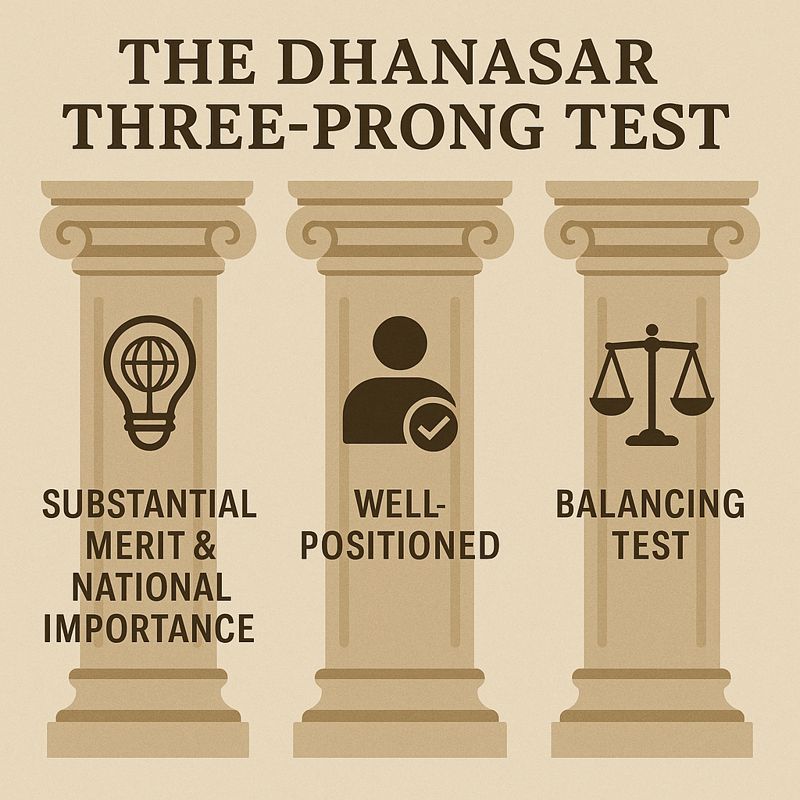
Dhanasar replaced this with a more flexible three-prong test. This new framework allows for a broader interpretation of national interest.
Another major improvement was the removal of the strict requirement that work must be national in scope. Under NYSDOT, applicants had to show that their work directly impacted the entire United States. This requirement made it difficult for those whose contributions were regional or industry-specific.
Dhanasar removed this restriction. It recognized that work with a local or regional focus can still have national importance. For example, efforts in economic development, public health, or scientific research can have a significant impact.
The new framework made it easier for specialized professionals, entrepreneurs, independent researchers, and small business owners to qualify. Under NYSDOT, it was challenging for self-employed individuals to obtain a National Interest Waiver (NIW). The test focused on traditional employment with an established organization.
Dhanasar also shifted the focus to the petitioner’s ability to advance their proposed endeavor. It prioritized their contributions over their specific job position. NYSDOT placed heavy emphasis on proving past success.
Dhanasar emphasized the future impact of a petitioner’s work rather than focusing solely on past achievements. Prior success remains an important factor. However, the new standard also recognizes your personal potential to contribute in the future.
Another critical shift was moving away from the requirement to prove that labor certification would harm the national interest. Previously, applicants had to show that going through the labor certification process would be detrimental to the U.S. This requirement was difficult and subjective.
Dhanasar replaced this with a balancing test. Which demonstrates that on balance, it would be beneficial for the United States to waive the job offer and labor certification.
This approach provides greater flexibility. It allows petitioners to argue their case based on positive contributions. They no longer need to focus on proving potential harm.
Overall, the Matter of Dhanasar modernized and streamlined the visa EB2 national interest waiver framework. It made it more inclusive and practical. It expanded opportunities for professionals in business, technology, healthcare, and entrepreneurs. A wider range of skilled individuals can now demonstrate how their work serves the national interest.
How Dhanasar helps EB-2 NIW self-petitioners
The green card self sponsorship allows professionals to self-petition without employer sponsorship. This is ideal for entrepreneurs, business owners, individual researchers, and tech professionals. It allows them to continue their work in the U.S. under an employment-based immigration pathway.
Here’s how Dhanasar benefits self-sponsored green card applicants:
More fields qualify under the new standard, including STEM professionals, healthcare workers, and business innovators. Petitioners do not need to prove that their work has an “immediate” impact. They only need to show that it is important to national interests.
Prepare a strong NIW petition under Dhanasar
A successful EB2 NIW I-140 petition requires solid evidence. You must show why your work is in the national interest and how you are well-positioned to advance it.
1. Prove your work has substantial merit and national importance
Substantial merit and national importance are distinct but related concepts in the Matter of Dhanasar framework. Substantial merit refers to the intrinsic value of the petitioner’s work. It assesses its significance in fields like business, technology, science, or healthcare. It focuses on the quality and usefulness of the work, regardless of its reach.
National importance considers whether the endeavor has a broad impact on the United States. It examines its influence on economic growth, public welfare, or technological advancement. This often means the work benefits the industry or society beyond the petitioner’s employer.
Examples of evidence to support substantial merit and national importance:
- Patents and innovation contributions
- Awards and recognitions
- Industry impact reports
- Media coverage
- Publications and citations (for researchers) – this is not mandatory, contrary to common belief
2. Demonstrate you are well-positioned
You need to prove you can advance your proposed work. Supporting documents might include:
- Resume/CV detailing your expertise
- Letters of recommendation from industry experts
- Expert opinion letters
- Promotions
- Salary
- Awards
- Patents
- Evidence of past success (project outcomes, business success, grants, or investments)
An immigration recommendation letter is a valuable piece of evidence. However, USCIS prefers objective evidence over personal endorsements which might be subjective. This means that a letter alone is not enough to prove you are well-positioned to carry out your proposed endeavor. Similarly, educational credentials or past projects by themselves will not be sufficient to meet this requirement.
3. Justify the waiver of labor certification
Your petition should explain why your work should bypass the traditional labor certification process. This can be demonstrated through:
- Unique skills not easily found in the U.S. labor market
- Above average skillset
- Contributions that advance key national priorities (e.g., cybersecurity, cost of energy, healthcare improvements)
- Urgency of national priorities
- Poor usability of labor certification, if you are a business owner or entrepreneur
An expert opinion letter can strengthen your argument by validating your expertise and national impact.
NIW petition letter package
A well-prepared petition letter package includes:
- A persuasive petition letter (known also as cover letter) detailing how you meet the Dhanasar criteria
- Supporting evidence of contributions
- Reference letters or letters of recommendation for immigration
- Forms like I-140 and ETA-9089
Using Selfpetition AI can help ensure your petition and reference letters follow USCIS guidelines.
National Interest Waiver examples
Here are some common NIW EB-2 applicant profiles:
- Tech Entrepreneurs – Innovators in AI, blockchain, cybersecurity or healthcare who create technology that benefits the U.S.
- Logistics and Supply Chain Experts – Professionals improving supply chain efficiency through automation and predictive analytics.
- Business Process Engineers – Individuals enhancing operational efficiency and cost reduction in key U.S. industries.
- Software Engineers – Developers creating critical applications and systems that drive technological advancement.
- Data Scientists – Experts leveraging AI and big data to solve complex problems across industries.
- Nurses or Physicians – Healthcare professionals addressing medical workforce needs and improving patient care.
- Security Engineers – Specialists protecting U.S. infrastructure, businesses, and government entities from cyber threats.
Our EB2 NIW self-petition examples highlight how diverse professionals qualify under Dhanasar.
EB-2 NIW approval rate
Since the change, EB2 NIW approval rate is significantly higher than before Dhanasar. Read about the most recent, EB2 NIW approval rate 2024 article. Factors affecting NIW approval rate include:
The strength of the evidence is crucial, including publications, patents, funding, and recommendations. The relevance of the work to national priorities also plays a key role. A well-structured petition that follows USCIS standards increases the chances of approval.
Many applicants receive EB2 NIW I-140 approved by carefully following the Dhanasar framework.
Final thoughts
The Matter of Dhanasar changed the game of self-petitioning for a green card. It opened opportunities for professionals to qualify under a more flexible standard.
If you plan to file an EB2 NIW I-140, make sure your petition clearly demonstrates your work’s national importance. Demonstrate that you are well-positioned to advance your work successfully. Include a strong immigration letter of recommendation to support your case.
A well-prepared petition letter package increases your chances of success. Review national interest waiver examples and use a sample I 140 petition as a guide.
With careful preparation, you can self-sponsor your EB-2 NIW green card and advance your career in the United States.


